Nutrition
Creatine After 40: The Supplement Women Were Never Told About
A 2026 review of trials in postmenopausal women found a small but real edge in lean mass and strength. Here is what the research does and does not show.
By Tyre Richards, BSHA, MBA · Published
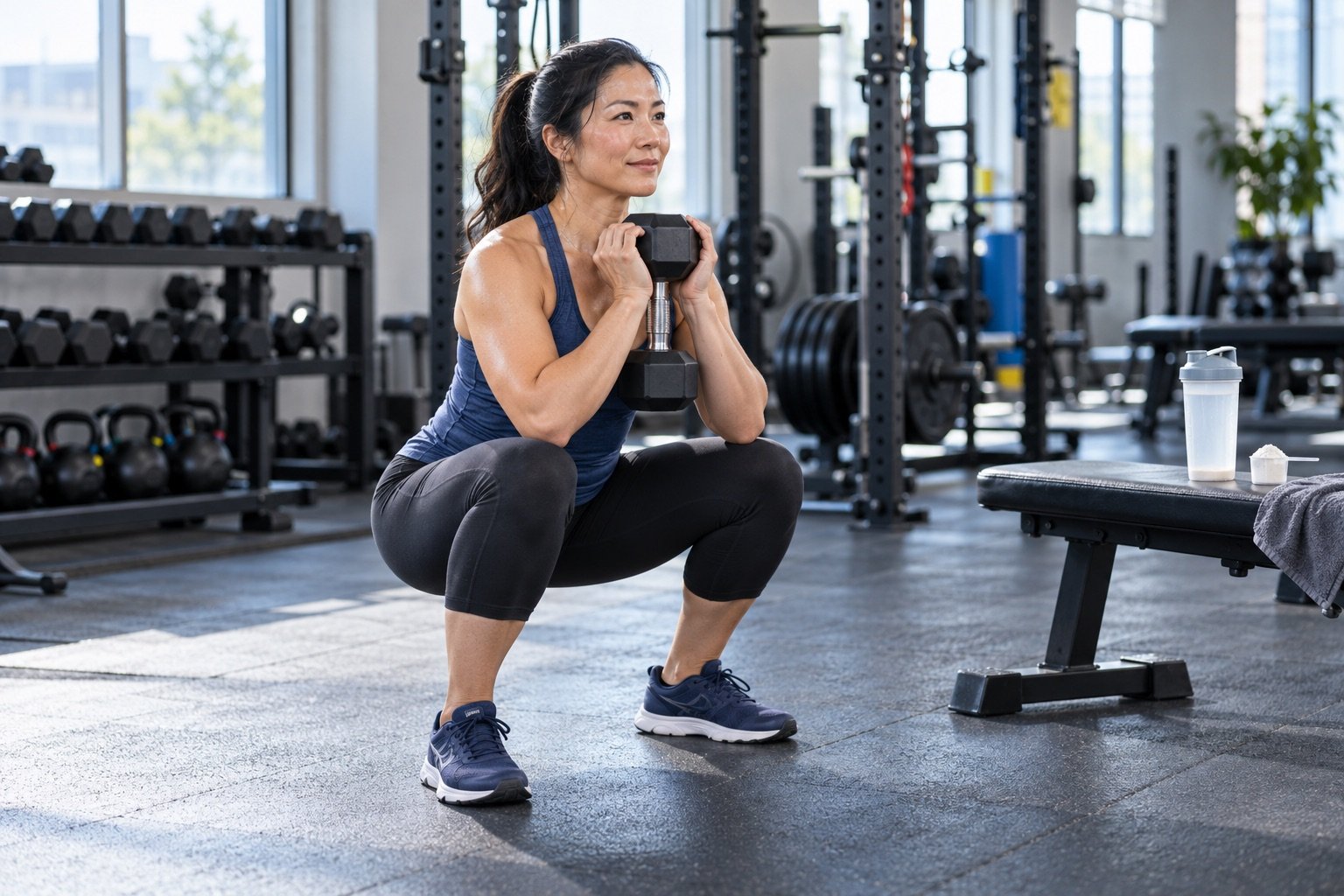
Walk into any supplement aisle and look at where creatine lives. It’s on the bottom shelf, in a giant tub, with a label that looks like it was designed for a man who deadlifts a truck.
That packaging has done women a disservice. For decades, a compound that is among the most studied in sports nutrition was marketed to everyone except the women who may need it most.
The research is now catching up, and it’s more interesting than the marketing ever let on. It is also smaller than the internet wants you to believe. So let’s take it apart carefully, and you can decide for yourself.
First, what it actually is
Creatine isn’t a hormone, a stimulant, or a fat burner. Your body makes some every day, and you get a little from meat and fish. About 95 percent of it is stored in your muscles, where it helps your cells regenerate energy for short, hard efforts: standing up from the floor, carrying groceries up the stairs, finishing the last two reps.
Your brain uses it, too, and that detail is why researchers have started asking questions about mood and thinking. More on that below.
Why midlife is when this conversation starts
Somewhere after 40, women begin losing muscle, and the loss tends to speed up around menopause as estrogen falls. This matters more than most of us were told. Muscle is what keeps your metabolism steady, your bones loaded, your balance reliable, and your independence intact at 80. Women also tend to live longer than men, which means more years when strength decides how independent you stay.
Lifting, protein, and sleep are what protect muscle. Creatine’s role, if it has one, is to give your muscles a small advantage when you ask them to work. That is the only case worth making for it.
What the best evidence actually says
A 2026 review gathered every placebo-controlled trial it could find of creatine in postmenopausal women, whose average age was about 62.
Lean mass: Women taking creatine carried about 0.37 kilograms more lean mass than women on placebo. That’s under a pound.
Strength: Creatine users gained about 7.5 kilograms more on the leg press, roughly 16 pounds.
Bone density: No overall change.
Safety: Side effects were mild and similar to placebo, and kidney markers didn’t change.
The gains are small, and I’d call them a modest edge. There’s an important caveat in the fine print: the benefit showed up when women took about 5 grams a day and combined creatine with resistance training. In trials that used 3 grams or less without lifting, researchers found no measurable effect. Dose and lifting went together in those trials, so nobody can say yet which one mattered more.
The other limits matter too. The strength result comes from just a few small trials. The review wasn’t registered in advance, most of the studies carried at least some risk of bias, and the lean mass gain is small enough that a future trial could land closer to zero. Real, but early.
Creatine and the brain
You’ve probably seen the headlines about creatine and brain fog. Here is what’s solid: your brain runs on a lot of energy, and creatine is part of how brain cells keep that supply steady. Smaller studies suggest it may support mood and thinking, especially under stress or poor sleep.
What isn’t solid yet: large trials in perimenopausal and menopausal women showing it clears brain fog. Those trials don’t exist, so treat anyone promising that result with caution.
What it won’t do
It won’t build muscle by itself. If you’re not lifting something heavy enough to challenge you, don’t expect much.
It won’t replace protein, sleep, or a real conversation with your doctor about hormones.
And it may add a pound or two of water weight in the first couple of weeks, because creatine draws water into the muscle. That isn’t fat, and it settles.
Who should check with a doctor first
In healthy adults, creatine has a long safety record. The key word is healthy. If you have kidney disease, diabetes, or high blood pressure, take medications that affect your kidneys, or are pregnant or nursing, talk to your doctor before you start. Ask for a kidney function check, since a basic blood panel will do it. Creatine can raise creatinine, a common kidney marker, without any harm to your kidneys, so tell whoever reads your lab results that you take it.
If you decide to try it
- Choose creatine monohydrate. It’s the form with the most research, and it’s usually the cheapest.
- Look for third-party testing, like NSF Certified for Sport or Informed Sport, because supplements aren’t tightly regulated.
- Take about 5 grams a day. That’s roughly a level teaspoon, stirred into coffee, a smoothie, or water. Timing matters far less than showing up every day.
- Drink water throughout the day.
- Lift two or three times a week. This is where the benefit lives.
- Give it two or three months before you decide whether you notice anything.
I’m in favor of anything with decent evidence that helps women stay strong, and creatine qualifies as a reasonable thing to raise with your doctor. It isn’t magic. The foundation is still lifting, eating enough protein, sleeping, and getting the care you need.
The thing I like most about this research is what it says about how we’ve treated women’s bodies. For years, we were left out of the studies and told the answers wouldn’t apply to us anyway. Now the data is arriving, and it shows that the muscles of a 62-year-old woman can still respond, and that she’s worth studying.
Scripture is honest about the body wearing down, and just as honest about what keeps going.
“Therefore we do not lose heart, but though our outer person is decaying, yet our inner person is being renewed day by day.”
2 Corinthians 4:16 (NASB)
Take care of the body you have so it can carry the life you still want to live.
Sources
- Naddafha S, Antonio J, Kreider RB, Stout JR. “Creatine monohydrate for lean mass, strength, and bone density in postmenopausal women: a systematic review and meta-analysis.” Journal of the International Society of Sports Nutrition, 2026.
- Smith-Ryan AE, et al. “Creatine Supplementation in Women’s Health: A Lifespan Perspective.” Nutrients, 2021.
- Kreider RB, et al. “International Society of Sports Nutrition position stand: safety and efficacy of creatine supplementation in exercise, sport, and medicine.” Journal of the International Society of Sports Nutrition, 2017.
This article is for education and isn’t medical advice. Talk with your own doctor before starting any supplement.
Scripture quotations taken from the (NASB®) New American Standard Bible®, Copyright © 1960, 1971, 1977, 1995, 2020 by The Lockman Foundation. Used by permission. All rights reserved. www.Lockman.org