Community & Connection
Hobbies as Medicine: What the Research Says About Doing Things Just for You
The research on hobbies, depression, and longer lives keeps pointing the same direction. What it can and cannot say, and how to give yourself permission.
By Tyre Richards, BSHA, MBA · Published
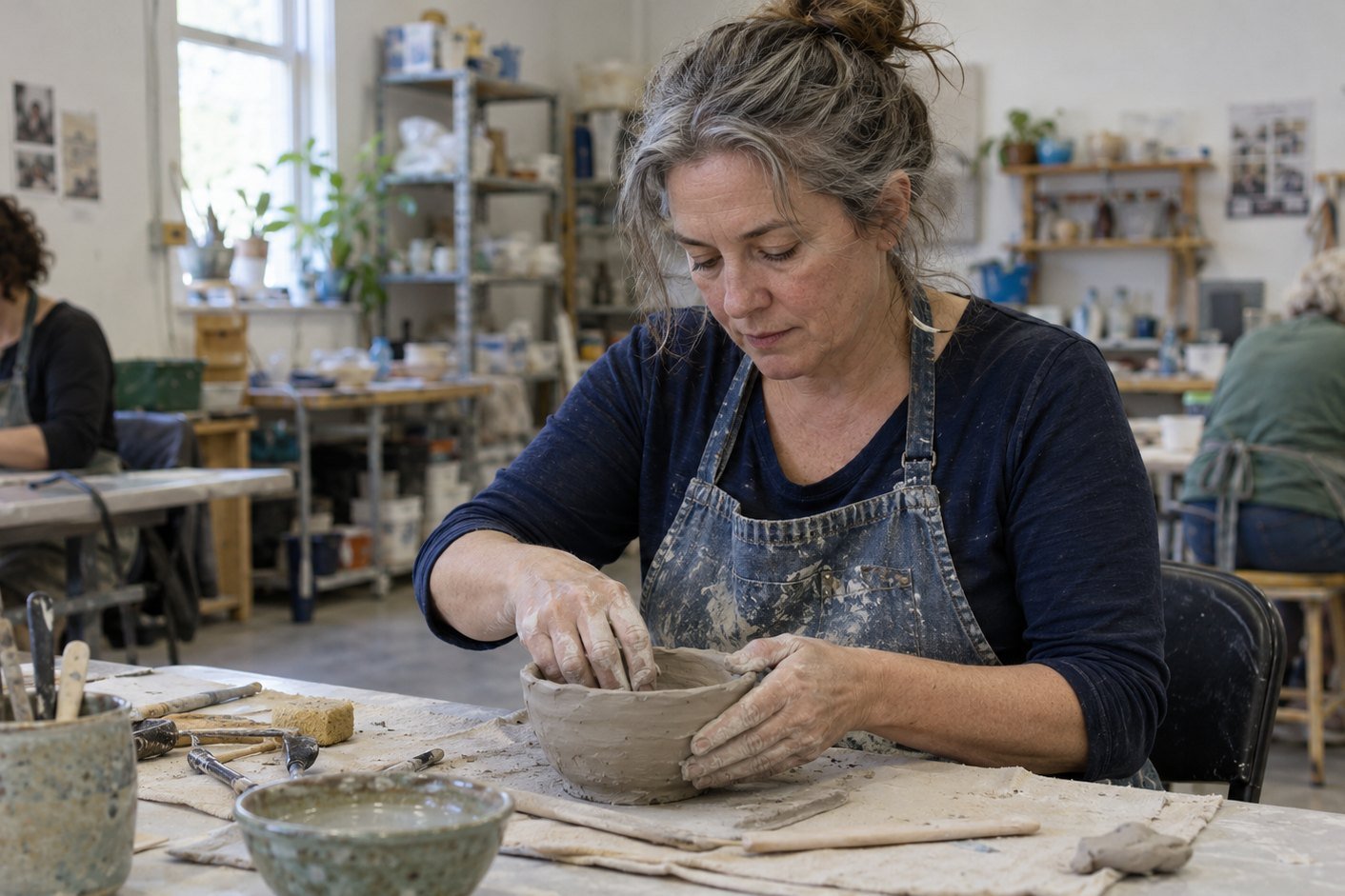
A lot of women reach midlife with a long record of doing things for other people and a short record of doing things for themselves. Work, children, parents, a household, a community. When a free hour does appear, a hobby can feel like dessert, something to earn after everything else is finished.
The research on this is worth a look, because the studies keep pointing the same direction, in different countries and with different methods. People who have hobbies and take part in activities they enjoy tend to have better mental health and, in some studies, longer lives.
What the studies found
Depression. The Health and Retirement Study followed 19,134 adults over 50 in the United States from 2008 to 2016, measuring leisure activities every four years and depression every two. Joining clubs, doing hobbies and projects, and baking or cooking were each linked to lower depression, even after the researchers accounted for other factors. A summary of the study from the Creative Aging Resource reports that older adults who engaged in creative activities were about 20 percent less likely to experience depression, both right away and two years later.
Longevity. In a 2019 study published in the BMJ, researchers at University College London followed 6,710 adults aged 50 and older in England for 14 years. They looked at going to museums, galleries, exhibitions, the theatre, concerts, and the opera. According to a summary of the paper, people who went even once or twice a year had a 14 percent lower risk of dying during the follow-up than people who never went. Part of that gap was explained by differences in thinking skills, mental health, and physical activity, and the association remained after the researchers adjusted for factors like age, health, and wealth.
Hobbies and purpose. A Japanese study of community-dwelling older adults followed participants for mortality records between 2011 and 2014. People who had neither a hobby nor a sense of purpose in life had about twice the risk of dying during follow-up (hazard ratio 2.08) and a higher chance of declining in daily activities, after adjusting for age, sex, BMI, income, alcohol, smoking, chronic disease, cognitive function, and depression. The authors concluded that hobbies and purpose may extend both longevity and healthy life expectancy, and noted that effects tied to cognitive function and depression could not be ruled out.
What the research cannot say
These are observational studies. People who are healthier, more mobile, and better off financially are more likely to have hobbies in the first place, and researchers can adjust for many of those differences without removing all of them. The London study measured arts engagement at a single point in time. Nobody has shown that a pottery class prevents disease.
So the word “medicine” in the title is a figure of speech. There is no dose and no prescription. What can be said is that the direction is consistent, the cost is low, and the downside is small.
What seems to matter
Research reviewing leisure activities and health finds that different kinds help in different ways. A 2023 paper in Frontiers in Public Health notes that leisure activities involving physical exercise reduce the risk of cardiovascular death, and that social leisure activities improve emotional wellbeing and reduce symptoms of depression and anxiety, especially in people who are socially deprived. In the depression findings above, the activities that stood out were ones where you make something or take part in something, like clubs, projects, and cooking.
In practice, that points toward a hobby with at least one of three ingredients. It gets you moving, it puts you around other people, or it gives you something to make or learn. A walking group has the first two. A choir has the second and third. A garden plot can have all three.
Giving yourself permission
Many women find that the hardest part is feeling allowed to have a hobby at all. If you are used to being productive, the hobby may need a rule that it never has to earn money, never has to be shared online, and never has to be good. It only has to be yours.
Even Jesus told His tired friends to step away from the crowd for a while:
“Come away by yourselves to a secluded place and rest a little while.”
Mark 6:31 (NASB)
A few ways to make it easier to start:
- Pick something you can do on a regular schedule, even if the time slot is small.
- Choose something that includes other people at least some of the time.
- Give it a trial of a month before you decide whether it fits, so you are not judging it after one awkward session.
- Let it be a beginner’s version for as long as you want.
“There is an appointed time for everything. And there is a time for every matter under heaven…”
Ecclesiastes 3:1 (NASB)
You spent years looking after everyone else’s health. This is a small, low-cost way to look after your own.
Pause and pray
A question to sit with: What did I love doing before everyone needed something from me?
A prayer for this week: Lord, thank You for the gifts and interests You placed in me. Give me permission to enjoy them without earning it, and help me find people to enjoy them with. Amen.
Take this further
Not sure what you would choose? Who She Was Made to Be is free in the Guides & Tools library.
Sources
- Engagement in leisure activities and depression in older adults in the United States: Longitudinal evidence from the Health and Retirement Study (National Library of Medicine, PMC)
- Creative Aging Resource, Lifetime Arts. Summary of the Health and Retirement Study findings on creative activities and depression
- Fancourt D, Steptoe A. The art of life and death: 14 year follow-up analyses of associations between arts engagement and mortality in the English Longitudinal Study of Ageing. BMJ, 2019. UCL news release and summary from the English Longitudinal Study of Ageing
- Lessons from the Literature, International Association for Hospice and Palliative Care newsletter (14 percent finding)
- Relationship of Having Hobbies and a Purpose in Life With Mortality, Activities of Daily Living, and Instrumental Activities of Daily Living Among Community-Dwelling Elderly Adults, Journal of Epidemiology (PubMed)
- Mind-stimulating leisure activities: Prospective associations with health, wellbeing, and longevity, Frontiers in Public Health, 2023
This article is for education and is not medical advice. If you are struggling with low mood, please talk with your doctor or a mental health professional.
Scripture quotations taken from the (NASB®) New American Standard Bible®, Copyright © 1960, 1971, 1977, 1995, 2020 by The Lockman Foundation. Used by permission. All rights reserved. www.Lockman.org