Identity
The Woman You Were Is Not Behind You
When a chapter closes, it can feel like you have to become someone new. You do not. You are every woman you have been along the way.
By Tyre Richards, BSHA, MBA · Published
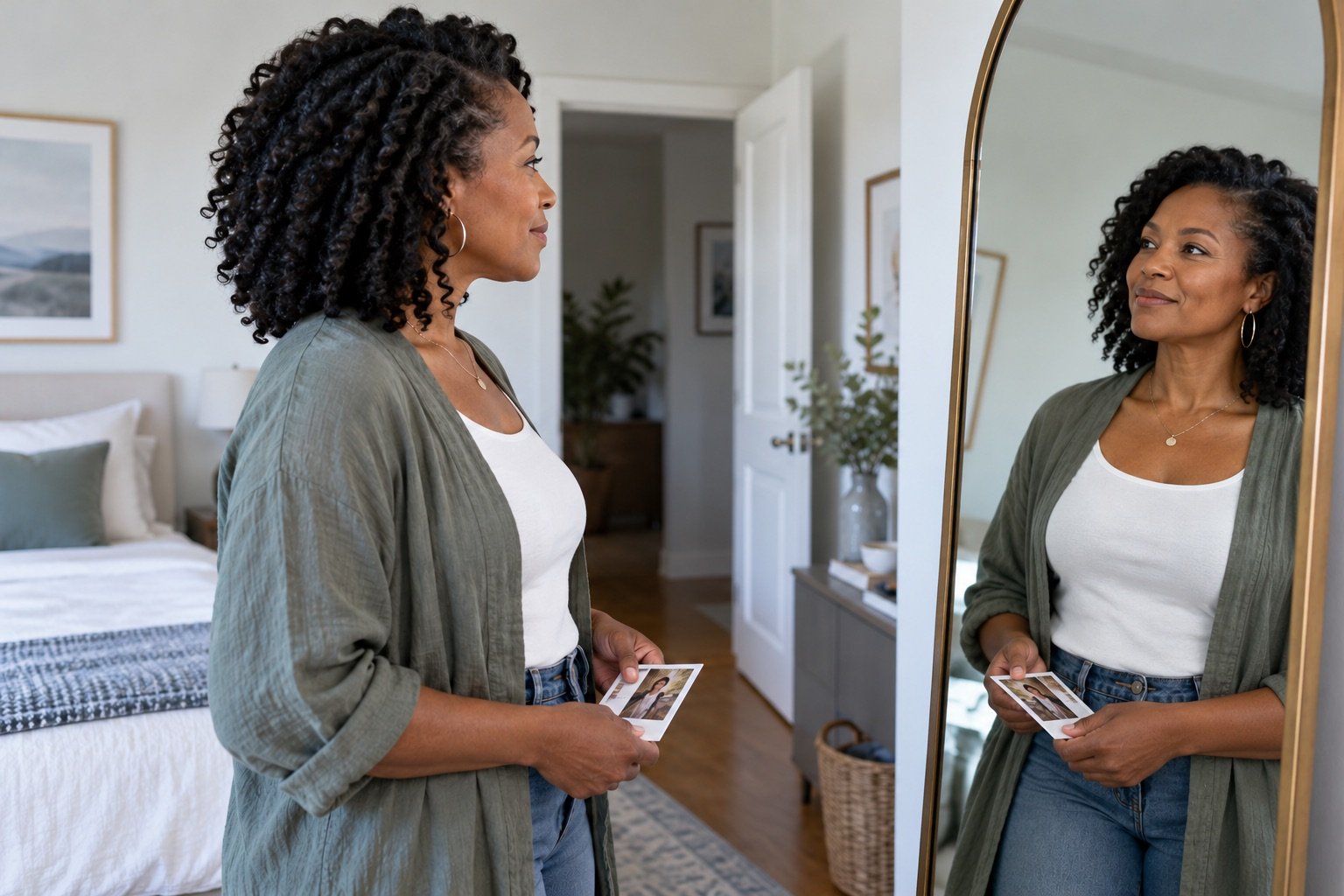
Sometimes a woman tells me she feels like she has to become someone new.
Maybe a marriage ended. Maybe the children grew up and left, or the career changed shape, or her body started asking for different things. Maybe nothing dramatic happened at all, and one ordinary morning she realized the life she built no longer fits the person living it.
I understand that feeling. I’ve walked through seasons like that, and I want to offer another way to look at it, because the story most of us tell ourselves at that moment isn’t quite true.
The story says: that woman is gone, and I have to build a new one from scratch.
But you are never just the woman you are today. You are every woman you have been along the way.
The girl who had a lot to say
At some point, you had dreams you hadn’t yet been talked out of. You had curiosity. You had opinions that surprised the adults around you, and a sense that the world was large and you were allowed in it.
Some of that got set aside, usually for good reasons. Life asked for responsibility, and you answered.
The things we set down don’t disappear. They wait. A skill you stopped using, a talent you quietly shelved, a part of you that went silent while you handled everything else. Women come back to those parts in midlife all the time, and they say the same thing: oh, there you are.
The woman who carried it all
Then there’s the next version of you. The one who worked, who planned, who raised, supported, and held things together. The one who learned to be steady while she was afraid.
It’s easy to look back at her and see only how tired she was. Look again.
She learned what people are like when things get hard. She learned how money behaves, how long grief takes, and what her own limits feel like from the inside. She made mistakes, some of them expensive, and she’s the reason you don’t make them now.
She was practice for the woman reading this, and none of her effort was wasted.
When experience makes you more careful
Experience doesn’t only make us braver. Sometimes it makes us more afraid.
When you’ve been hurt, you know exactly how it feels, and you remember it vividly. When you’ve lost something, you understand what’s at stake in a way a younger woman can’t. That can make a new beginning feel heavier than it did at twenty-five.
That carefulness is useful information. You can be hopeful and discerning at the same time, wanting something good and still looking closely before you say yes to it. That combination is rare, and it’s built entirely out of the years you lived.
What comes with you
Every season leaves something behind that you can use:
- Your judgment. You can read a room, a person, and a situation faster than you could at thirty.
- Your resilience. You’ve been through hard things and you’re still here.
- Your relationships, the real ones, which sorted themselves out over time.
- Your taste, your standards, and your sense of what’s worth your time.
- Your voice, the one that no longer needs permission.
None of it expires because a chapter closed.
Research fits what many of us feel here. A study that tracked people’s emotions over ten years found that emotional life tends to get better with age. Older adults reported more positive feelings and steadier days than younger ones. Years of living seem to teach us something about how to handle what comes.
Letting go without erasing
Some things do need to end. A role, a habit, a story you’ve told about yourself for too long. Releasing those is healthy, and it’s often how you finally make room.
Letting go does not have to mean disowning. You can close a season and still honor it. You can say, “I’m not that woman anymore,” and also say, “I’m grateful for what she made possible.”
The women I’ve seen move forward most gracefully are the ones who stopped treating their past selves as a problem to be fixed. They treat them as the people who got them here.
Psychologists who study nostalgia have found something that backs this up. When people recall a cherished memory from earlier in their lives, they tend to feel more like the same person they have always been, they find more meaning in their lives, and they feel more hopeful about what’s ahead. Warm remembering seems to give people a steadier place to step forward from.
A question to carry
What did the version of me from ten years ago make possible?
Ask it about the woman from twenty years ago, too. Ask it about the girl. You may find that you owe them more than you realized, and that they would be proud of where you stand.
You aren’t behind. You’re not starting from nothing. You are the sum of everything you’ve lived, and you’re still becoming.
Scripture describes a woman who carries this kind of settled strength:
“Strength and dignity are her clothing, And she smiles at the future.”
Proverbs 31:25 (NASB)
She can smile at the future because she isn’t afraid of her own history.
Bring all of her with you.
Sources
- Sedikides C, Wildschut T. “Finding Meaning in Nostalgia.” Review of General Psychology, 2018.
- Carstensen LL, et al. “Emotional Experience Improves With Age: Evidence Based on Over 10 Years of Experience Sampling.” Psychology and Aging, 2011.
Scripture quotations taken from the (NASB®) New American Standard Bible®, Copyright © 1960, 1971, 1977, 1995, 2020 by The Lockman Foundation. Used by permission. All rights reserved. www.Lockman.org